

This article is inspired by a question someone asked in my Reddit AMA thread the other day. I said in that thread “I will come back and continue answering questions each day until it seems fair or reasonable that I stop.”, and I meant it. I haven’t been able to revisit it every day, which I hope you consider to be fair and/or reasonable at this point. Let’s get on with it.
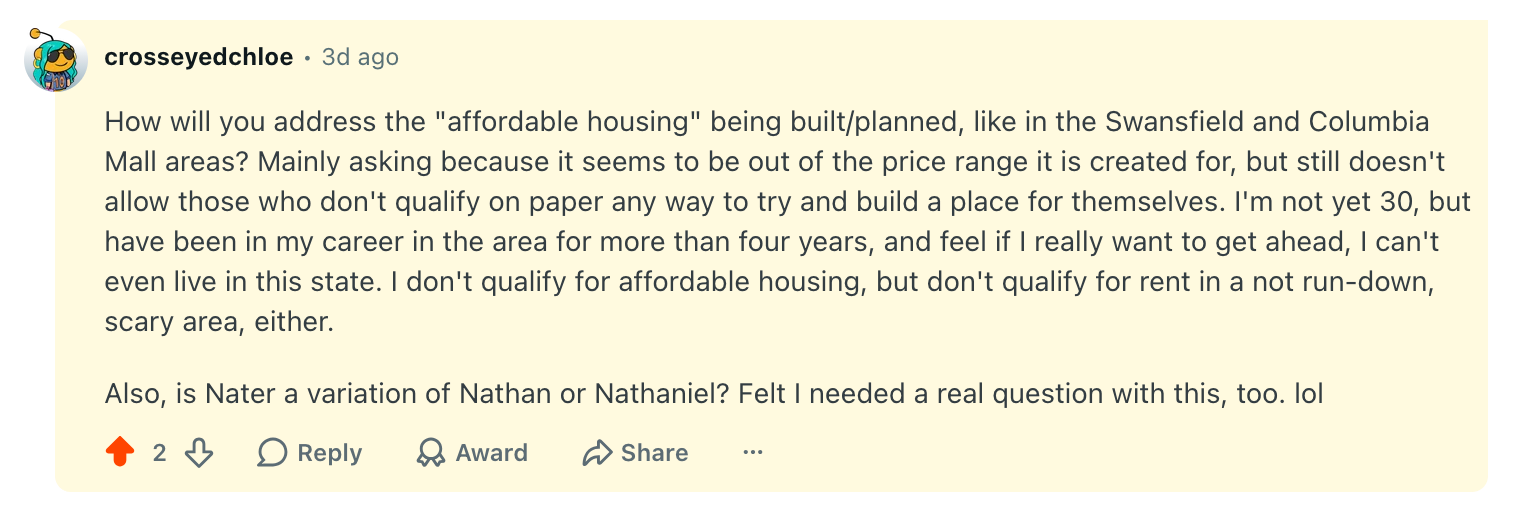
u/crosseyedchloe
How will you address the “affordable housing” being built/planned, like in the Swansfield and Columbia Mall areas? Mainly asking because it seems to be out of the price range it is created for, but still doesn’t allow those who don’t qualify on paper any way to try and build a place for themselves. I’m not yet 30, but have been in my career in the area for more than four years, and feel if I really want to get ahead, I can’t even live in this state. I don’t qualify for affordable housing, but don’t qualify for rent in a not run-down, scary area, either.
Also, is Nater a variation of Nathan or Nathaniel? Felt I needed a real question with this, too. lol
Both are fair questions, u/crosseyedchloe.
Howard County’s challenge in creating “affordable housing” starts with the cursed definition of the term “affordable housing” itself. What’s wrong with the term is that it’s entirely subjective. According to HUD, “Affordable housing is generally defined as housing on which the occupant is paying no more than 30 percent of gross income for housing costs, including utilities.” I don’t think that’s very helpful because it describes what they consider affordable for anyone, and it’s subjective.
So when we have “affordable housing” initiatives, the government will use language like “to households earning 60-80% of the Area Median Income (AMI),” or “no more than 200% above Federal poverty guidelines.” In my opinion, a local government that cares about its working class will talk about the Federal poverty guidelines; otherwise, you’ll see references to median incomes when they want to avoid referencing their most economically vulnerable residents.
To put those terms in perspective:
a living wage in Howard County is estimated to be
$68,000 per year, approximately $34/hr
200% of the Federal poverty guidelines is
$31,920 per year, approximately $16/hr
60-80% of AMI is
$89,000 - $119,000 per year, approximately $45/hr - $60/hr
So, depending on which terminology is used, you can easily see who a program aims to benefit.
In Howard County, our median household income is estimated to be just shy of $150,000. In contrast, our median per capita income sits closer to $80-85k. (Think of median as like saying average, but the way it’s calculated is less at risk of being affected by extremes or outliers)
Welcome to the middle, where everything is too expensive, but you’re not so totally screwed that you qualify for help. By not offering real services or programs for people who are paid less than $85,000 per year, Howard County has been sending a clear, passive-aggressive message: working-class people are not welcome here.
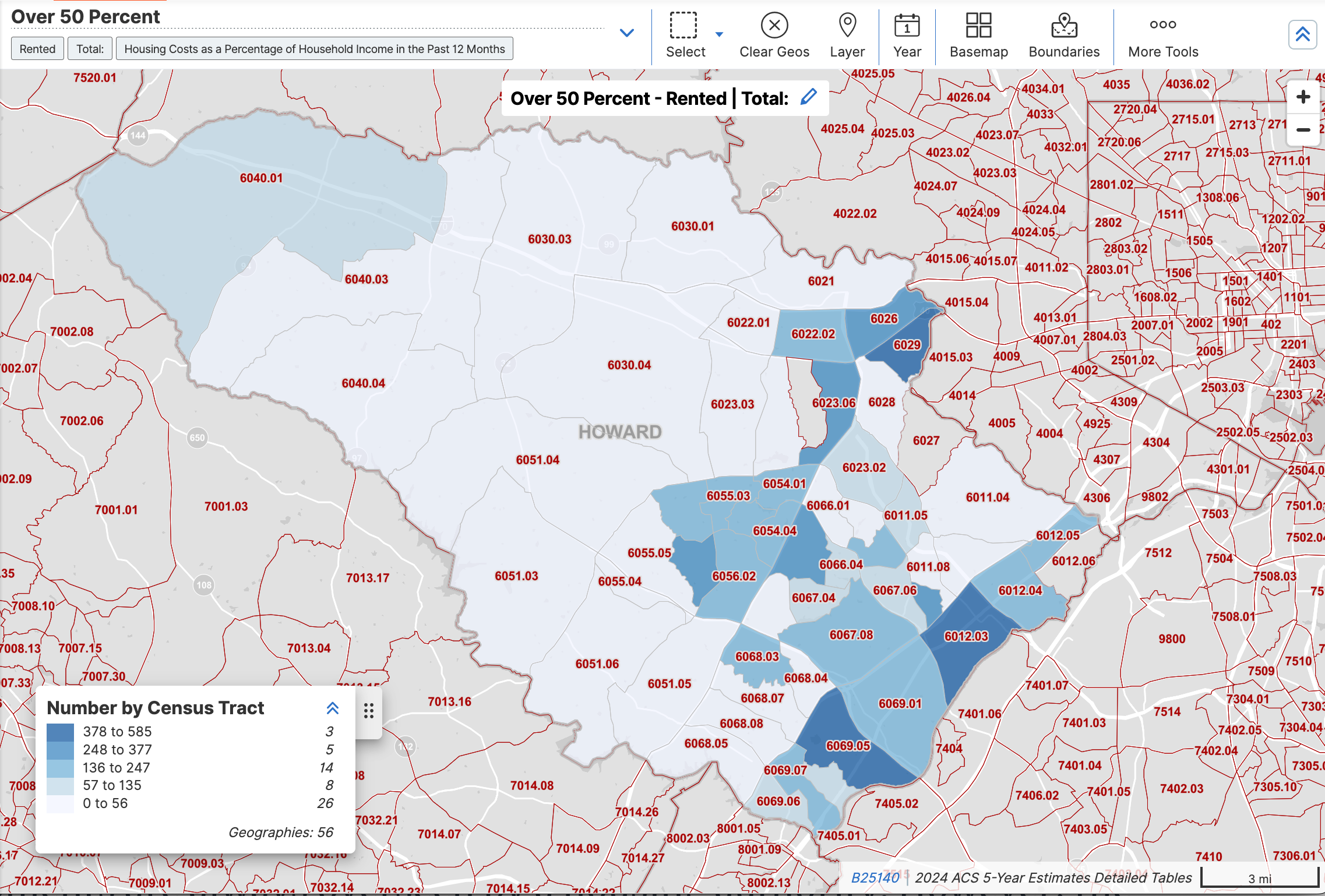
There is a ton we can do to close the gap
You might have noticed that companies tend to pay workers as little as they think they can get away with, unless they’re forced to pay more. And similarly real estate companies, developers, and landlords tend to charge as much as they think they can get away with, unless they’re compelled to charge less. The popularity of voucher programs, marketed under the auspices of giving people choice, are really welfare programs for businesses, not people. Instead of telling a landlord to charge someone a fair rate, we give them money directly, so though the consumer may pay less, the landlord makes the same, if not more.
Ok, so where do we begin?
Step one: Defining what affordable means
Step one is to fix the definition of affordable housing and make it mean something real. I intend to introduce a bill that defines “affordable housing” as the amount of money a person paid minimum wage can afford to spend on housing, utilities, and connectivity services if they are working at least 37 hours a week, or the equivalent of a full-time job.
Then, when we talk about this apartment being affordable, or that building having so many affordable units, we can know who can actually afford to live there.
Step two: Keeping prices from getting more insane
For step two, we pass rent stabilization. Since things have been so out of control for so long, I propose capping annual increases at 2.25% or the CPI-U (Consumer Price Index), whichever is lower, as the least we can do. That means if you’re paying $2000/mo this year, the landlord can’t raise your rent to more than $2045/mo next year.
As far as the specific developments you mentioned- Swansfield and the claims of a future with affordable housing at Town Center- they are slightly different situations, as one is imminent and one is not. Waverly Woods in Swansfield is an Enterprise Community Partners, Inc. development project; they are a powerful developer that has nearly perfected the nonprofit industrial complex approach to commercial real estate development. The fact that they are a 501(c)(3) is a testament to how being a 501(c)(3) is little more than a legal tax shelter for many organizations. Their legal structure is interesting and can be found here.
Enterprise claims responsibility for over 1,000,000 rental units in the U.S. and that its mission is to provide affordable housing. Looking through their listings, I found a complex in HoCo that claims to offer a 1-bedroom apartment for as little as $1027 per month, excluding utilities. That’s about the least expensive you can find in the county, but how affordable is it?
According to HUD, a person working full-time at Howard County’s current minimum wage can afford $833 a month, including utilities. Let’s assume the utility costs, at today’s rates, may run $225 a month for that apartment. A person would need 1 1/2 full-time jobs to afford one of the least expensive apartments in the county. But it turns out that Enterprise has something they call a Resident Selection Plan. ( https://acrobat.adobe.com/id/urn:aaid:sc:us:2a5dc501-00e5-4938-82ff-015121ac6020 ) That plan states, “the household’s annual income must be 2.5 times the annual rent to meet the minimum qualifying income requirement.” They don’t specify whether they mean gross or net income. So Enterprise’s process could mean that to rent one of the cheapest apartments in the county, a person needs to be paid $30,810/yr (roughly $16/hr) or ~$45,000/yr (roughly $22.50/hr). For a minimum-wage worker, the rent for this apartment exceeds HUD’s affordable housing definition. And for a worker paid $22.50/hr, HUD says they can technically afford it, but only if their monthly utilities stay under $225.
Step three: Close the application trap
Anyone who has rented will know that people need to submit an application, almost always with a fee, whether it be $25 or $50 or more, even to be considered for a lease. This means landlords get to pick their tenants, but tenants don’t get to pick their landlords. And the more applications a landlord accepts, the more of an upper hand they have. If a landlord knows you’ve applied to live in five separate apartments because they own all of those apartments, they’ve collected maybe $125, maybe $250 of your money up front. They know, based on the information provided, that they can reject you for one place and put you in another, less desirable unit. From day one, it’s a relationship designed around a power imbalance,
I do think it’s reasonable, to a degree, for a landlord to want to make sure a new tenant can pay rent. Still, the information collected by background and credit checks can be used against you instead of only indicating that you can meet the terms of a lease. This is another area where local governments fail their residents. If you’re looking for an apartment, the county should offer validation services that landlords can use for a simple yes/no while protecting tenant candidates’ privacy and shielding them from housing discrimination. So when it’s time to apply for an apartment, a prospective renter submits standardized application information to a dedicated county office, pays a one-time fee if necessary, and then their application remains valid for a guaranteed period, like 90 or 120 days. Then landlords get a virtually empty tenant application. The landlord asks the county, “Can this applicant meet the terms of a lease?” and if so, the deal can be done. No unnecessary sharing of personal information with a landlord, no application-processing lead time to wait for, and no paying an application fee after application fee. That money adds up, and there isn’t a reason why someone who’s looking for an apartment should have to pay it more than once.
Step four: Pay a living wage
For apartments that are already too expensive, we can’t force landlords to lower their prices. So in addition to keeping rents from being unfairly raised with rent stabilization, we can do real things to make sure working people get paid a living wage. At the beginning, I talked about how a living wage in Howard County is around $34/hr, while the minimum wage is $16/hr. The fix is a no-brainer: raise the minimum wage and close the loopholes that let employers pay workers a subminimum wage.
We have to raise the minimum wage to $30 by 2030
We get rid of the tipped wage, and we get rid of other carve outs that support worker exploitation, like how workers who are younger than 18, work for a nonprofit, or work as a camp counselor are each allowed to be paid 85 cents on the dollar by their employer for some reason. I guess the message when that was signed into law is that those workers must just be worth less as people. I believe every working person deserves, at the very least, a living wage, so to get there we have to raise the minimum wage to $30 by 2030, and then keep it on pace with inflation from then on, in perpetuity.
Raising the minimum wage has been shown time and time again to have trickle-up effects that strengthen communities, first benefiting working-class households directly, then benefiting small businesses that offer local services (more than it costs them to employ workers) by increasing local spending power and expanding their customer base.
And then…
Future development activities, like what has been proposed for Town Center, would need to adhere to our new clear and specific definition of affordable housing; potential tenants would have a streamlined and cheaper application process, and our least economically mobile neighbors would get paid something close to what it requires to be able to afford to live here.
Raising the minimum wage has been shown time and time again to have trickle-up effects that strengthen communities, first benefiting working-class households directly, then benefiting small businesses that offer local services (more than it costs them to employ workers) by increasing local spending power and expanding their potential customer base.
My transportation initiative can further reduce the cost of living, working, or going to school in Howard County by providing a more convenient, less expensive way to get around than driving. If you didn’t need to drive, or could reduce the number of cars in your household, how much money might get freed up in your budget every month?
It’s time that Howard County made real shifts to become not just less hostile, but a community that welcomes working people.
There are a ton of regular, everyday things the county government can do to make life here less hostile. So what did I miss? If you’d like to comment on this article, it will always be free to subscribe. Let me know what you think we should be doing, how I’m doing it wrong, or what I, or anyone seeking public office, can do to help you better meet your needs.
Howard County deserves better.
You deserve better.
Oh, and about my name... Nater isn’t short for anything, but it is long for Nate. You’re welcome to think of it as an adjective, making me more “Nate” than all other Nates, whatever that could mean. Maybe it’s just silliness? The upside of a simple but uncommon name is that once people learn it, they tend not to forget it. Either way, I like my it because it’s mine.